 Low diatribe
Imposter cat
A handful of years ago, at 3 in the morning, a big fluffy orange cat mewled at our back door. I let him in. He was covered in burrs, his fur matted. "What did you get into, Ruckus?" I spent the better part of an hour cleaning him up, then went back to bed.
Three days later, our son walked upstairs carrying the big fluffy orange cat. "This isn't Ruckus," he said to my wife.
"Stop joking," she replied.
"This isn't Ruckus. This cat has white paws, but Ruckus is all orange." He paused. "Plus Ruckus is neutered, and this cat has balls."
I had let a stray doppelganger into the house. He'd pretended to be Ruckus for three days. Or rather, we thought he'd pretended — we have no actual visibility into the ways of cats. The next morning, Ruckus came waltzing in like he and Imposter had been pulling a country cat, city cat switcheroo all along.
I took Imposter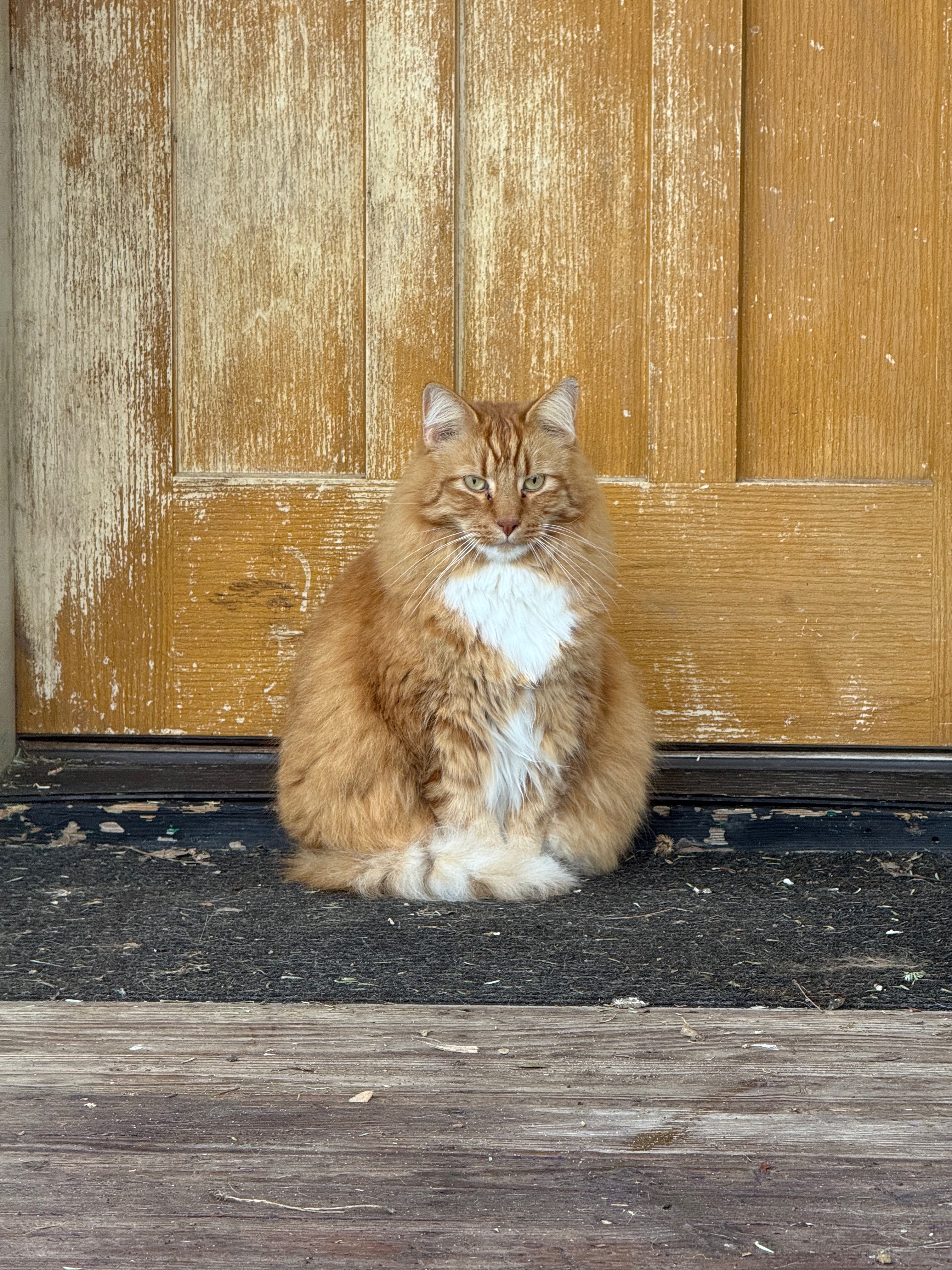 to the vet to check if he was someone's missing pet. He wasn't. So he came home again.
We live in an extremely rural area. Our cats are country cats and often go on walkabouts. Our nearest neighbor texted: her daughter had fallen in love with Imposter. Could she keep him?
Gladly, we replied.
Then we found Imposter on our couch.
Never mind, the neighbor texted. The cat wasn't as friendly as they thought.
He wasn't friendly to humans or cats as far as I could see. He never seemed to like it here. But he called this house home and never left.
For years, he lived at our house. Co-existing with his twin and the three elder cats who'd been here long before either of them arrived.
A little more than a year ago, one of our daughters had a bad mouse problem. We jokingly suggested she could have a fluffy orange cat — we had a spare.
She said yes.
So Maurice — as Imposter had eventually been named — or Moss for short, went to live as a mouse catcher at our daughter's house. We expected a message asking us to come get him immediately.
Instead: photos. Videos. A running commentary on how he's her perfect baby kitty boy and how much she loves him.
A month after that, our son moved out, taking Ruckus with him. The house was freshly out of fluffy orange cats.
Maurice had a lovely time being the only cat at our daughter's. He was a genuinely changed feline.
Until the first of this month, when our daughter moved into a new place that won't allow cats. Could Maurice come back?
We couldn't refuse.
Moss's first five minutes back in the house: he picked a fight with not one, but two of the elder cats. The ones who'd been here all along, the ones who remembered him.
My greatest fear is that he was gone during the introduction of Valya. There's no predicting how he'll react when confronting a starling in the house. All I can do is watch and not allow for conditions where something tragic could happen.
His reintroduction has not been smooth. I find myself trying to fix it like a leadership problem.
I can't. They're cats.
But I can learn from it.
Dealing with difficult environments. When to move the rock. When to let the system settle.
Mostly what I'm getting is a constant reminder to adjust my attitude.
If I expect Moss to be a nuisance, I'm hyper-aware of every little infraction. If I extend him the grace to acclimate to a new environment, I start to notice all the peaceful interactions he's had with the dogs. How he was actually hunting mice here, as opposed to the elder cats, who are either incredibly lazy or running a mouse protection racket.
So I'm being patient. Giving him time to adjust. Trying to find the balance between assumption of good intent and the reality that I have no basis for understanding cat motives. It's silly to even attempt to predict or control them.
This is a situation where I need to be my best self and treat Moss reasonably, even if he's incapable of returning the favor.
The cat who came back isn't the same cat who left. Neither is the house.
I keep wanting to solve for harmony. To engineer the right conditions. To intervene at the right moments with the right approach.
But some systems don't respond well to intervention. They respond to time, space, and the quality of attention you bring to them.
The work isn't fixing Moss. The work is noticing when I'm treating him like a problem to be solved instead of a creature adjusting to circumstances he didn't choose.
The work is catching myself in the act of confirmation bias: looking for evidence that he's difficult, that this won't work, that we made a mistake taking him back.
The work is choosing, again and again, to see what's actually happening instead of what I expect to happen.
He's not friendly. He sometimes picks fights. He also hunts mice while the other cats nap. He also coexists peacefully with the dogs. He also chose this house as home when he could have gone anywhere.
I don't know what motivates him. I don't need to.
I just need to create the conditions where he can settle. And notice when I'm the one making it harder.
How often do I do this with people?
Expect difficulty and find it everywhere. Interpret every action through the lens of past behavior. Forget that environments change people. Forget that people who struggled in one context might thrive in another.
Forget that coming back is harder than leaving.
Moss was a different cat at our daughter's house. Not because he changed his nature, but because the environment allowed different parts of his nature to emerge.
Now he's back in a place that holds old patterns, old conflicts, old expectations. Of course he's struggling. Of course he's defensive.
The question isn't whether he'll be the cat he was at our daughter's house. The question is whether I can create enough space for him to find his way in this environment.
And whether I can do that simply because it's what's needed.
I'm learning to notice the moment when I shift from observation to judgment. When I move from "Moss hissed at the other cat" to "Moss is the problem."
That shift happens fast. Faster than I'd like to admit.
Maybe Moss does the same thing. Maybe he doesn't pick fights with the elder cats because he's aggressive, but because he's struggling with something he can't name or fix. Transferring his frustration onto available targets.
I recognize that pattern. I do it too.
The practice is catching it, just noticing: I'm doing the thing again. I'm making this harder than it needs to be.
Then choosing differently.
Extending grace I don't feel. Assuming good intent I have no evidence for. Creating space for adjustment I can't control.
It's the only way forward that doesn't make me smaller.
Maurice/Moss, né Imposter, is teaching me that we're all in constant flux. Hopefully growing toward something better, but always changing. Always adjusting to circumstances we didn't choose and systems we can't control.
And that the change itself deserves grace. Not just in others, but in ourselves.
I'm struggling too, in my own way, with a system that changed while he was gone and changed again when he returned. I need time to adjust. Space to find my way. The same patience I'm trying to extend to him.
The same willingness to see what's actually happening instead of what I expect to happen.
I can't fix this. I can only show up as my best self and let the system settle.
That takes practice. More important than I realized. And necessary in ways I'm still learning.
Silvaris. Strength in quiet. Quiet as revolution.
 Low diatribe uses cookies to keep the experience smooth.