 Low diatribe
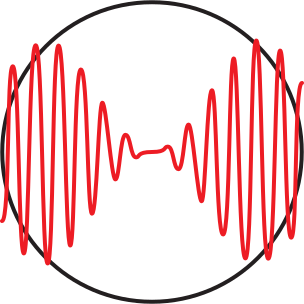
Oscillate wildly
You know the shower phenomenon.
The water's too cold, so you turn the knob toward hot. Nothing happens immediately, so you turn it more. Still cold. You turn it again. Then suddenly — scalding. You overcorrect toward cold. Now it's freezing. You adjust back. Too hot again.
You're not fixing the problem. You're adding complexity through oscillation.
The issue isn't the system. It's the lag between input and feedback. The water takes time to travel through the pipes, to register the temperature change, to reach you. But you're reacting to what you feel right now, not accounting for what's already in motion.
It feels like we're dialing in on the optimal solution. But each adjustment throws the system further out of alignment.
I've watched this same pattern play out in leadership. In teams. In organizational change. Someone identifies a problem and makes an adjustment. When results don't appear immediately, they adjust again. And again. Each correction compounding the last, until the system is oscillating wildly between extremes.
The team isn't responding fast enough, so we add more check-ins. Still not seeing results, so we add more structure. Now people feel micromanaged, so we pull back entirely. Now there's no accountability. We swing back the other way.
We're not managing the system. We're destabilizing it.
The problem isn't the adjustments themselves. It's the failure to account for lag. Systems have inertia. Changes take time to propagate. Feedback loops aren't instantaneous.
When you adjust before the previous change has had time to work through the system, you're not responding to reality — you're responding to the absence of immediate gratification.
I've learned that the hardest part of leadership isn't making adjustments. It's waiting to see if they work.
That pause — between action and reaction — is where most leaders lose their nerve. The discomfort of not knowing whether the change is working. The pressure to do something, anything, to show progress. The fear that waiting means accepting failure.
But sometimes the most important thing you can do is nothing. Let the system stabilize. Let the change propagate. Give the feedback loop time to complete.
This doesn't mean ignoring problems or avoiding course corrections. It means understanding the difference between a system that needs adjustment and a system that needs time.
I fall into this trap more often than I'd like to admit. I find something that works — a new practice, a better approach, a framework that clicks — and I embrace it wholeheartedly. If a little context helps, surely more context is better. I shift my focus to full-time information accumulation. Without realizing it my calendar becomes a solid wall of context-gathering missions, with no time to process any of it.
Moderation would win the day. But moderation requires restraint I don't always have when I think something will work.
I wrote recently about shrinking scope as a survival tactic. Focus on what's immediate. Control what you can control. It was good advice then, and I needed it. But I took it too far. I narrowed my view so completely to the immediate that I stopped seeing what was coming next. The slightly-after-immediate consequences blindsided me because I'd trained myself to look only at right now.
This is the oscillation in my own thinking. Survival mode says focus narrow. So I focus so narrow I can't see the edges. Then I get hit by something just outside my field of vision, and I overcorrect — try to see everything, plan for every contingency, account for every possibility. Mired in analysis paralysis.
The question I'm learning to ask isn't "what should I do?" but "is this a new problem, or am I just seeing the lag from the last adjustment?"
Usually, it's the lag.
The shower eventually reaches the right temperature. Not because you kept turning the knob, but because you stopped. You found the setting and waited for the system to catch up.
The challenge is staying patient enough within the system to learn its patterns. In my house, the left knob open all the way with the right knob open just a bit gives me a good starting point. I know from experience it takes about six or seven minutes for the water to stabilize at that setting, and I can fine tune from there. That knowledge only came from not panicking during the lag.
The same is true in leadership. The adjustment you made last week, last month, last quarter — it's still working its way through the pipes. The feedback you're getting now isn't about whether the change was right. It's about whether you gave it time to work.
Oscillation feels like responsiveness. It feels like you're engaged, attentive, adaptive. But what it actually creates is harmonic dissonance. People can't find their footing when the ground keeps shifting. Teams can't build momentum when the direction keeps changing.
Stability isn't the same as stagnation. It's the foundation that allows change to take root.
The leaders I've followed who create the most sustainable change aren't the ones who adjust constantly. They're the ones who adjust deliberately, then hold steady long enough to see what happens.
They account for lag. They resist the urge to react to every fluctuation. They understand that systems need time to stabilize before you can know whether the adjustment worked.
This requires a different kind of discipline. Not the discipline of action, but the discipline of patience. The willingness to sit with discomfort. To trust that the change is working even when you can't see it yet.
The shower will get hot. The system will stabilize. But only when you stop turning the knob.
Maybe the most important adjustment we can make is learning when not to adjust at all.
Silvaris. Strength in quiet. Quiet as revolution.
 Low diatribe uses cookies to keep the experience smooth.